You Think You Know Someone, 2.0
"The ice age is comin', the sun's zoomin' in. Meltdown expected, the wheat is growin' thin. Engines stop runnin', but I have no fear. 'Cause London is drownin' and I live by the river." -- London Calling, The Clash

Go read London Falling right now (please); plus Black bibliophiles, renovating the Paris Catacombs, and a few things I'm enjoying.
Hello again. How are you doing?
And hello to a couple of new readers who signed up for a weekly dose of Paigeness. I hope you enjoy these weekly missives, which sometimes include things I've been working on, and a lot of times include little things that I find interesting or weird or inspiring, etc. My hope is that whatever winds up in these letters is something that gives you a break, or something to think or laugh about, or something to check out or do in your spare time. The way that I ensure that is by inviting you to reach out and let me know what's on your mind. So write me! Don't be shy!
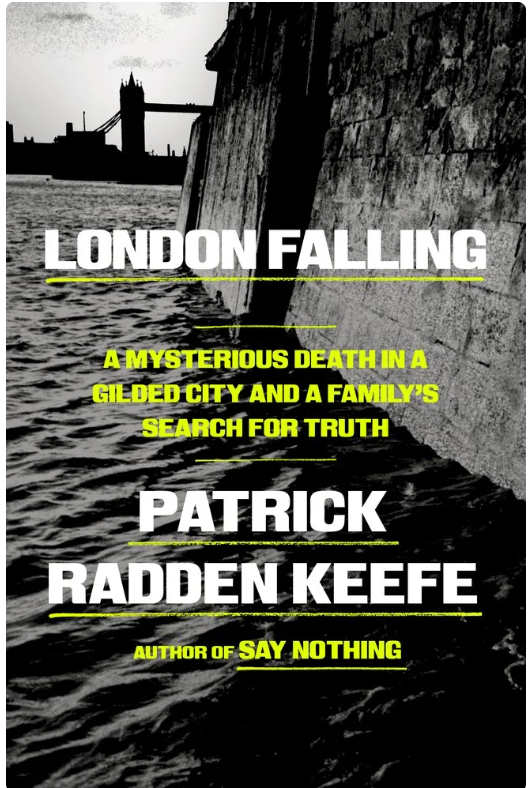
Here's something that's been on my mind this week: Patrick Radden Keefe's latest unputdownable masterpiece London Falling: A Mysterious Death in a Guilded City and a Family's Search for Truth. You know, one of the things parents accept is that their kids won't all turn out the same way. Some might be timid and perfectionistic. Others might be hellraisers, or class clowns, or something else. All you can do is love them, support them, and indicate in as non-suffocating a way as possible that you are there for them if they need you. That's how Londoners Matthew and Rachelle Brettler raised their sons Joe and Zac, at least, and things were fine for a time. The family lived in the upper-middle-class, seriously-cute-and-nonthreatening London neighborhood of Maida Vale and both boys attended nice private schools. But then Zac became really obsessive about oligarchs, and money, and tough guys, and was occasionally combative at home. Worried, Rachelle got him counseling, and for a time Zac seemed to improve. But deep down, a parent always knows when something doesn't seem right with their kid, and so they get the impression that another shoe is about to drop. After Zac went missing and was later found dead, Matthew and Rachelle learned that there was a whole hell of a lot they didn't know about their youngest son, who tried an identity on for size (he is not the first 19-year-old to do so, and certainly won't be the last) and quickly got in over his head.
Keefe, a New Yorker staff writer, learned about Zac's story – and his parents' grief – while he was in London filming the series based on his book Say Nothing: A True Story of Murder and Memory in Northern Ireland. After interviewing the Brettlers and other relevant parties, and sifting through Scotland Yard files, Keefe's piece about the mishandled case originally appeared in magazine form. But the tale was made for this longer, richer treatment set in the shadows of London, where characters aren't as they seem. It is a powerful, exquisitely structured (a masterclass in structure, I'm telling you) story involving family histories, immigration, unimaginable wealth, growing pains, and true crime in a changing metropolis. If you're looking for something amazing to read right now, this is it. It broke my heart, took my breath away, outraged me, taught me things I didn't know, and did all of the other things that good nonfiction should do. I suspect it will do the same for you too, so be sure to grab a copy at your local independent bookseller! Then, hug your kids if you have them.
Here's hoping you all have a wonderful weekend ahead. Hit reply and let me know what you've got planned if you're so inclined.
Until next week,
Paige
P.S. For the newbies, here's my "You Think You Know Someone" post from a few weeks ago.
Writing prompt: Write about a secret you kept from your parents. What was it and how did you feel they'd react if you ever told them? Did you ever share that secret with them after a certain amount of time? If so, why? If not, why not?

Anyone who writes is a seeker. You look at a blank page and you're seeking. The role is assigned to us and never removed. I think this is an unbelievable blessing.
-- Louise Gluck
Endnotes
"Damned Old Fools on Books"

By 1926, Harlem Renaissance figure Arturo Schomburg had amassed a collection of 4,600 books, works of art, pamphlets and other items from five centuries of Black history and culture. His collection had taken over his modest rowhouse in New York City, until the New York Public Library swooped in to buy it for $10,000 and store it in a much larger space. After that, libraries serving Black communities and historically Black colleges and universities began forming Black culture collections of their own. But, as Dr. Laura E. Helton writes in a recent LitHub piece, while "these were the first Black libraries in public, but they weren’t the first collections to serve Black publics." Like Schomburg, many other Black bibliophiles turned rooms in their home into publically accessible places where the Black community could come and read about their own history and culture. LitHub sheds light on that moment and highlights a forthcoming exhibit about Schomburg's collection, which has since become the acclaimed Schomburg Center for Research in Black Culture. I hope you'll give it a read, or even see the exhibit if you're in New York City sometime between May 7 and December 5 this year.
Good Bones

Almost 15 years ago, my kid and I went to Paris together. High on the kid's sightseeing list: The Catacombs, the centuries-old underground labyrinth that contains the remains of six million Parisians whose bones have been artfully stacked into macabre mosaics. It's gloomy down there. The air is thin. Sometimes water drips on your head and you wonder if the droplets contain the DNA of some old serial killer, or something, and what happens if their soul inhabits yours and no one is safe? You ponder mortality and pray that when you die (we all do) your kid doesn't arrange your bones like this for all the world to see someday. It could happen. The Catacombs are proof of that. As The New York Times reports, architects, designers, technicians, and masons have been renovating the enormous old tomb to make it brighter and more accessible to visitors. Unsurprisingly, it was hard to find workers who were willing to work 60 feet underground in cramped spaces full of bones. “If you really think about the task, it’s inhumane work,” one worker said, adding that he had seen some unforgettable sights like twisted limbs and punctured skulls. Another gazed around the ossuary to note that it "puts us back in our place as mortals."
Things I'm Enjoying

The news that local popsicle purveyor King of Pops has created eight new flavors inspired by teams playing in Atlanta for the World Cup. Starting May 1, I know I'll be on the hunt for Doce de Coco, Halawa, and Mint Tea pops. Also: Writer Jami Attenberg's Substack post on how some writers need to cut themselves slack because life has a way of life-ing, which makes it hard to finish writing projects. Jami will be in Atlanta next week, giving a talk on creativity, and persistence, and all of the important things. Tickets for that are here. And? The new Duran Duran song "Free to Love" – and its shiny, disco-tastic video – has me hoping that the band has a new album on the way.
If you get a minute...
...Saturday, April 25 is Independent Bookstore Day. Go find a few good reads for yourself at one near you!
Paige Bowers Newsletter
Join the newsletter to receive the latest updates in your inbox.